Network Models
A network is a combination of hardware and software that sends data from one location to another. The hardware consists of the physical equipment that carries signals from one point of the network to another. The software consists of instruction sets that make possible the services that we expect from a network. We can compare the task of networking to the task of solving a mathematics problem with a computer. The fundamental job of solving the problem with a computer is done by computer hardware. However, this is a very tedious task if only hardware is involved. We would need switches for every memory location to store and manipulate data. The task is much easier if software is available. At the highest level, a program can direct the problem-solving process; the details of how this is done by the actual hardware can be left to the layers of software that are called by the higher levels. Compare this to a service provided by a computer network. For example, the task of sending an e-mail from one point in the world to another can be broken into several tasks, each performed by a separate software package. Each software package uses the services of another software package. At the lowest layer, a signal, or a set of signals, is sent from the source computer to the destination computer. In this chapter, we give a general idea of the layers of a network and discuss the functions of each.
LAYERED TASKS
We use the concept of layers in our daily life. As an example, let us consider two friends who communicate through postal maiL The process of sending a letter to a friend would be complex if there were no services available from the post office.
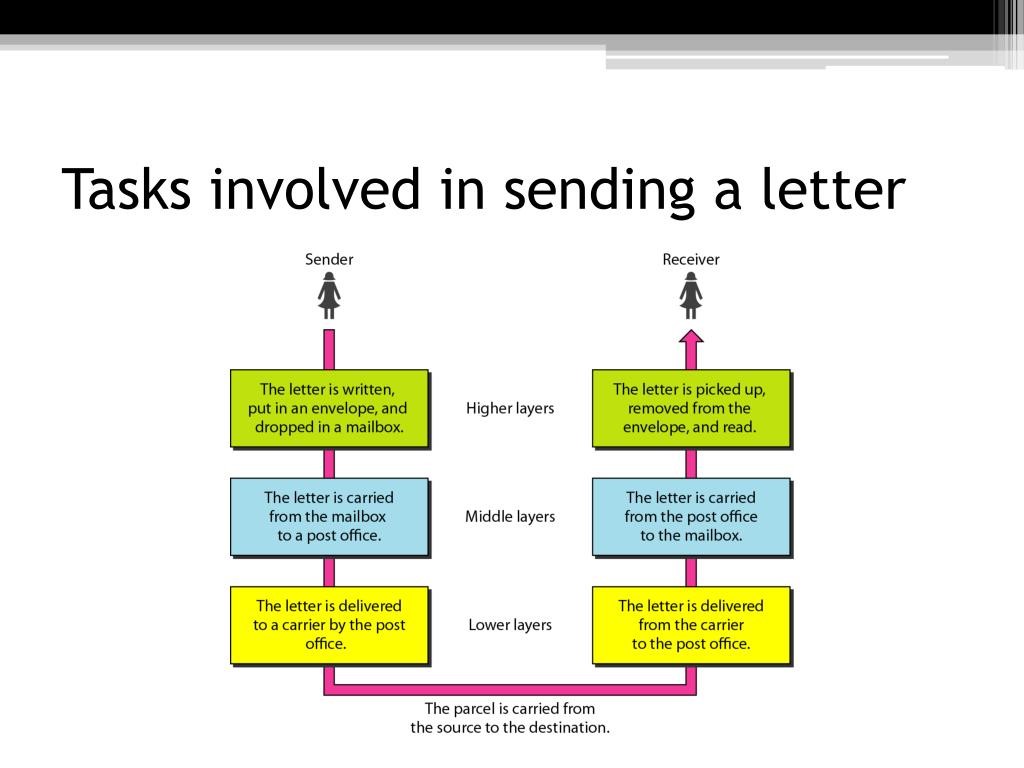
Sender, Receiver, and Carrier
In Figure we have a sender, a receiver, and a carrier that transports the letter. There is a hierarchy of tasks.
At the Sender Site
At the Sender Site
- Higher layer. The sender writes the letter, inserts the letter in an envelope, writes the sender and receiver addresses, and drops the letter in a mailbox.
- Middle layer. The letter is picked up by a letter carrier and delivered to the post office.
- Lower layer. The letter is sorted at the post office; a carrier transports the letter.
On the Way
The letter is then on its way to the recipient. On the way to the recipient’s local post office, the letter may go through a central office. In addition, it may be transported by truck, train, airplane, boat, or a combination of these.
At the Receiver Site
- Lower layer. The carrier transports the letter to the post office.
- Middle layer. The letter is sorted and delivered to the recipient’s mailbox.
- Higher layer. The receiver picks up the letter, opens the envelope, and reads it.
Hierarchy
According to our analysis, there are three different activities at the sender site and another three activities at the receiver site. The task of transporting the letter between the sender and the receiver is done by the carrier. Something that is not obvious immediately is that the tasks must be done in the order given in the hierarchy. At the sender site, the letter must be written and dropped in the mailbox before being picked up by the letter carrier and delivered to the post office. At the receiver site, the letter must be dropped in the recipient mailbox before being picked up and read by the recipient.
Services
Each layer at the sending site uses the services of the layer immediately below it. The sender at the higher layer uses the services of the middle layer. The middle layer uses the services of the lower layer. The lower layer uses the services of the carrier. The layered model that dominated data communications and networking literature before 1990 was the Open Systems Interconnection (OSI) model. Everyone believed that the OSI model would become the ultimate standard for data communications, but this did not happen. The TCPIIP protocol suite became the dominant commercial architecture because it was used and tested extensively on the Internet; the OSI model was never fully implemented. In this chapter, first we briefly discuss the OSI model, and then we concentrate on TCPIIP as a protocol suite.